
Predicting the unpredictable: How to avert pipeline failures
Cutting-edge research is helping oil and gas operators keep pipelines safe and more reliable under extreme conditions.
Oil and gas wells in the Middle East operate under some of the harshest conditions encountered by structural materials. High pressures, elevated temperatures, and the presence of hydrogen sulfide create an environment where conventional carbon steel can rapidly lose its mechanical integrity. In such sour conditions, hydrogen penetrates steel, reducing its toughness and increasing its susceptibility to cracking and failure, a phenomenon known as sulfide stress cracking.
The industry has relied for decades on corrosion-resistant alloys to mitigate this risk. While effective, these materials are costly and increasingly difficult to justify for short-life wells. This has raised a critical question for operators such as the Abu Dhabi National Oil Company (ADNOC). Can cheaper carbon steel be used safely in sour environments if we can predict and control when it might fail?
What really causes steel pipes to fail
Hydrogen sulfide doesn’t just corrode steel—it sneaks inside its microstructure, where they weaken atomic bonds and promote brittle fracture. Cracks can initiate at microscopic defects and grow slowly over time, leading to sudden failure under loads that would otherwise be safe.
Crucially, these cracks do not appear suddenly. They often remain dormant before propagating under sustained loading. Temperature changes, pressure fluctuations, and chemical exposure accelerate this process, making failure difficult to predict using traditional assessment tools. “Being able to say how long you can operate before it becomes unsafe is extremely valuable,” says Dr. Imad Barsoum, from the Department of Mechanical and Nuclear Engineering at KU.
“This project shows what is possible when industry-challenges drive academic research innovation.”
Imad Barsoum
Now, Dr. Barsoum, Dr. Alok Negi, and PhD researcher Mohamed Elkhodbia have found a way to accurately predict crack initiation and growth naturally without predefining their path, while simultaneously coupling crack evolution with hydrogen diffusion, temperature, and mechanical loading.
Rather than asking whether a crack is safe at a single moment, the framework predicts time-dependent crack growth and remaining safe operating life, which is critical for modern wells with evolving environmental conditions.
A key insight emerged when residual stresses from pipe manufacturing were incorporated into the simulations. Even at moderate levels, these stresses significantly accelerated crack growth and, in some cases, dominated the failure process before operational loads became critical. This highlighted residual stress as a primary variable capable of shortening service life from the outset.
From simulation to fast engineering decisions
While detailed simulations provide deep insight, they are computationally intensive. To enable rapid engineering assessments, the research team trained a physics-informed artificial neural network using the simulation database. The model generalizes fracture predictions across a wide range of crack geometries and loading conditions, providing an alternative to traditional failure assessment methodologies. “What we developed is essentially a modern replacement for the old diagrams,” says Dr. Barsoum.
In parallel with the advanced simulation and AI-driven integrity assessments, the project placed strong emphasis on corrosion mitigation through chemical inhibition. This work was supervised by Prof. Akram AlFantazi, from KU’s Chemical and Petroleum Engineering Department, and involved experimental investigations and modeling carried out by PhD researcher, Ghadeer Mubarak, and Dr. Chandrabhan Verma, on corrosion inhibitors designed to reduce steel degradation and limit hydrogen ingress in sour environments.
Using electrochemical testing and surface analysis, the team examined how inhibitor molecules adsorb onto carbon steel surfaces and form protective films under aggressive conditions. The stability and persistence of these films directly influence corrosion rates and hydrogen uptake, which in turn affect fracture behavior. “Corrosion inhibitors work at the molecular scale,” Mubarak explains.
By linking inhibitor performance to mechanical integrity predictions, the team demonstrates how chemical protection strategies complement multiphysics modelling and AI-based assessment, providing a more complete framework for extending the safe use of carbon steel in short-life wells.
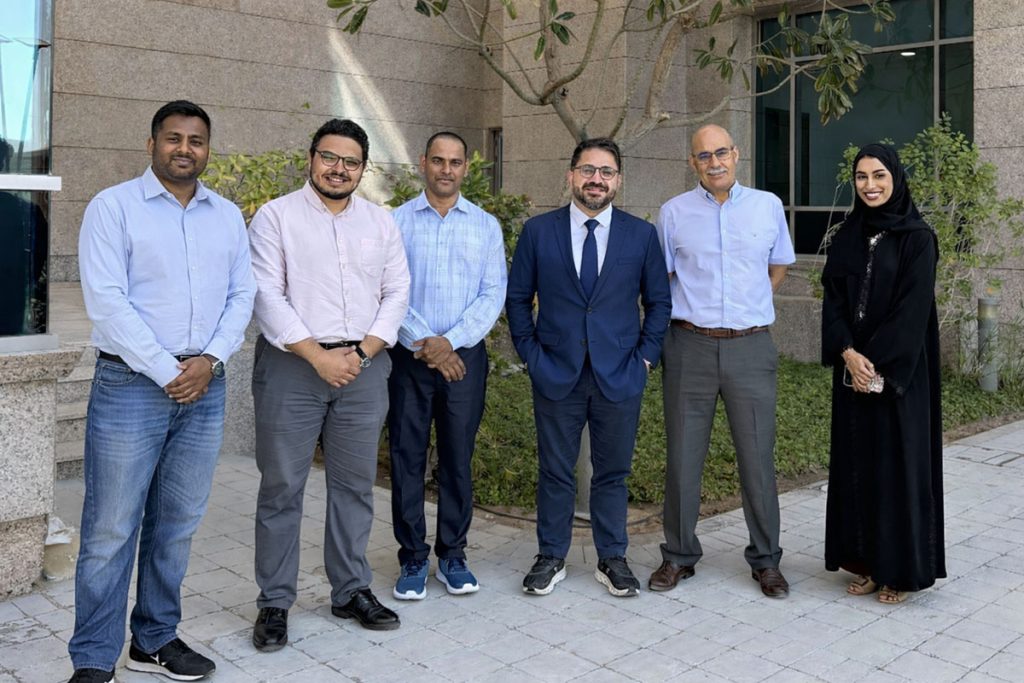
Weekly discussions among the team members ensured tight integration between modelling, experiments, and industry needs. “We meet weekly in my office. There’s a large screen on the wall. We think together, test ideas together. Very few of our papers are written by just one person,” Dr. Barsoum says.
An integrated industry-academia ecosystem
Bringing the project to a close at the end of 2025, the strategic collaboration launched in 2022 by ADNOC’s R&D division, led by Raymond Burke and his team, and KU stands as a clear example of the value created through a well-integrated industry–academia ecosystem. By aligning industrial challenges with academic innovation over the course of the project, the partnership enabled the development of robust, predictive tools tailored to sour-service operations and real-world engineering decision-making. Reflecting on the outcome, Dr. Barsoum notes: “This project shows what is possible when industry-challenges drive academic research innovation.”