

From carbon neutral to carbon useful
A strategic investment from ASPIRE R&D yields promising results for a solar-powered system that converts carbon dioxide into valuable products.
Scientists around the world are racing to curb global warming by reducing levels of carbon dioxide in industrial and transport emissions and by developing cleaner, greener fuels. But what if CO2 could also be captured and turned into valuable products?
Carbon capture and conversion is a rapidly growing research field, and scientists at Khalifa University’s Department of Chemistry are spearheading ways of generating valuable products from CO2 reduction.
“It’s vital that we learn how to convert CO2 efficiently and effectively,” says Ahsan Ul Haq Qurashi, an associate professor of chemistry. “People might think of CO2 and its byproducts, such as carbon monoxide, as toxic chemicals, but they’re actually incredibly useful as feedstock in multiple industries.”
In the United Arab Emirates and beyond, using CO2 reduction products would be a tangible contribution toward achieving net zero, says experimental chemist Bilal Masood Pirzada. “These products are important chemical building blocks for numerous uses, from fertilizers and plastics, to synthetic gas and clean fuels,” he adds.
The team’s aspirations didn’t go unnoticed, and caught the attention of innovation accelerator ASPIRE, based in Abu Dhabi, which supports researchers to turn their ideas into reality. In 2021, Faisal Al Marzooqi, Deputy Director of the Center for Membranes and Advanced Water Technologies (CMAT) and Associate Professor at the Chemical & Petroleum Engineering Department at KU, and his colleagues received a prestigious research grant from the ASPIRE Award for Research Excellence (AARE), giving their work momentum to push boundaries in carbon conversion.
“For the UAE and beyond, using CO2 reduction products is a tangible contribution toward achieving net zero.”
Bilal Masood Pirzada
“This proposal was one of five chosen in the energy sector, reflecting its excellence and potential significant impact, and its relevance to the UAE economy,” says Václav Jurčíček, Director of R&D Ecosystem Performance at ASPIRE. “The team’s approach not only helps minimize carbon footprints but also leverages CO2 products as sustainable feedstock.”
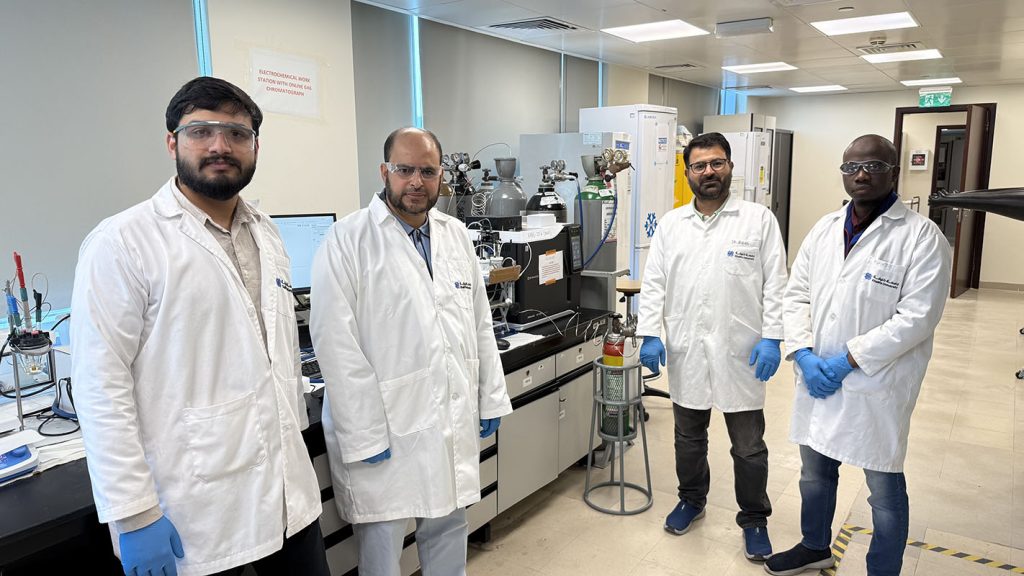
The team initially lacked the state-of-the-art laboratory facilities needed to explore CO2 reduction reactions. “The support from ASPIRE kickstarted this entire project,” says Qurashi.
ASPIRE funded the lab equipment and infrastructure needed for the detailed, in-depth investigation of photo-electrochemical CO2 reduction, including the technologies to conduct analyses and refinement of the products produced.
Value from CO2
Chemical reduction of CO2 can lead to a wide range of products—some are more complex than others. The simplest are C1 products, which are single carbon molecules, such as carbon monoxide, formic acid and methane. These are easier to generate because the reaction involves fewer electron transfers.
“The production of carbon monoxide from CO2 has progressed rapidly; one company in the Netherlands is establishing a full-scale pilot plant,” says Qurashi. “This gives us real hope for the future of C2 product synthesis.”
Multi-carbon molecules include vital industrial chemicals such as ethylene, ethanol and acetaldehyde, but generating these is far more complex. The process needs to be as sustainable as possible.
Many challenges remain, both within the production and scaling up of C2 products. That’s why the KU team is focusing on designing stable catalysts to improve the efficiency and selectivity of C2 product generation.
“A major challenge with electrochemical CO2 reduction is that the reaction pathway can lead off in multiple directions. Distinct intermediates form during the process, leading to multiple products,” says Pirzada. “It takes careful fine-tuning of catalysts to generate the exact products you want to make, and this is particularly true of complex C2 product molecules.”
“Selectivity is key; refining the structure of the catalyst on the cathode side of the reaction makes a critical difference to the products created,” Qurashi says.
Curated copper nanoclusters
With their new facilities the team began creating advanced catalysts. To enhance C2 selectivity, they experimented with copper in different forms and discovered that atomically precise copper nanoclusters were particularly promising1,2.
“Our copper nanoclusters, which are just tens of copper atoms protected by surrounding molecules, or ligands, are a fascinating material for catalysis,” says Qurashi, whose team noted a direct correlation between the ligand’s concentration and the resulting product selectivity.
“We’ve achieved almost 97% selectivity for C2 compounds using copper-palladium based electrocatalysts1; only 3% of the products were C1 compounds,” he says. “This means that the creation of intermediates was likely suppressed by our electrocatalyst.”
The team is also improving the overall green credentials of C2 product generation and has developed a specialized photo anode for its system.
“We harvest energy from solar, allowing the anode to generate hydrogen ions that flow to the cathode and facilitate the CO2 reduction reaction,” says Qurashi. “When we build full conversion cells, we plan to integrate them into photovoltaic panels, which would supply the cells with continuous solar energy.”
“We’re excited to build a functional prototype of our solar-driven photo-electrochemical system,” says Pirzada.
“We are grateful to ASPIRE for investing time and money in support of our work on CO2 conversion, and for believing in our vision for a cleaner future,” Qurashi concludes.
References
- Pirzada et al. Ultrasonic treatment-assisted reductive deposition of Cu and Pd nanoparticles on ultrathin 2D Bi2S3 nanosheets for selective electrochemical reduction of CO2 into C2 compounds Ultrasonics Sonochemistry 112 (2025).
- Butt, A.M. et al. Method-induced isomerism and concentration mediated isolation of two (Cu14 and Cu41) atomically precise copper nanoclusters. Chem. Methods 5, e202400031 (2025).
- Alminu, A. et al. Fe foam supported FeVO4 nanoparticles for electrochemical nitrogen fixation at ambient conditions. Nano Research Energy 4 (2) (2025).
- Musa, S. et al. Growth of copper-nickel (Cu-Ni) dual atom catalysts over graphene variants as active anodes for clean oxygen generation: Integrative experimental and computational validation. NanoEnergy 125: 109479 (2024).
- Adeosun, W. et al. Sulfolane-based solid-state electrolyte for high-capacity rechargeable zinc-air batteries operating at a wide temperature range. Journal of Power Sources 654: 237744 (2025).