
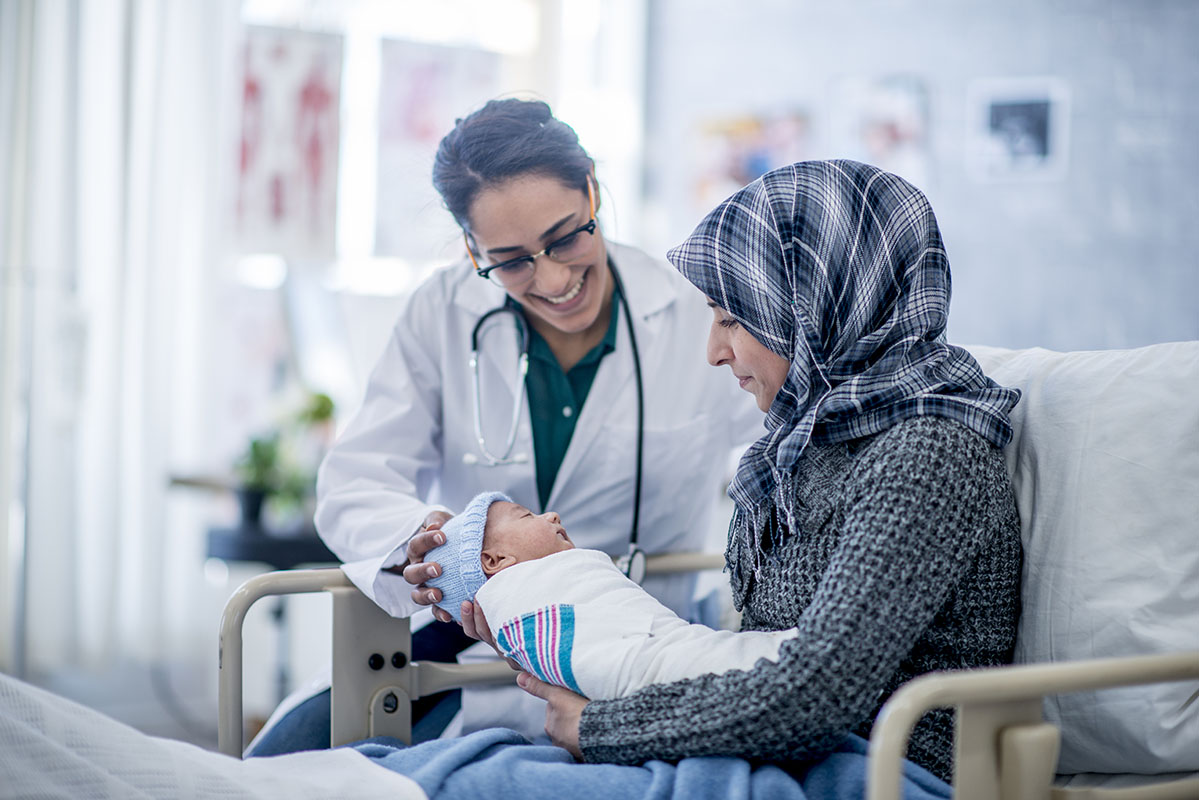
Beyond birth: Abu Dhabi redefines mother and baby healthcare
A collaborative program turns data into action by bridging research, healthcare and policymaking for better mother and child care.
Data on the mental and physical health of mothers and their babies before, during and after pregnancy are limited, not just in the United Arab Emirates but across the world. This lack of understanding and insight carries serious consequences. Poor maternal health can lead to complications during childbirth, long-term health issues for mothers and developmental challenges for children.
The health and wellbeing of new mothers and their babies is crucial, yet in-depth, long-term studies conducted into maternal and infant health have historically been few, says Ayman Al-Hendy, gynecologist and chair of the Medical Sciences Department at Khalifa University.
The scientists and policymakers at the heart of the Maternal and Infant Health Monitoring System for Abu Dhabi program are working hard to change this, for Abu Dhabi, the wider UAE and beyond.
“I’m really impressed by how [quickly we can turn] robust scientific evidence into [government] policy in the Emirates. It’s reassuring as a scientist because you know your hard work pays off.”
Ayman Al-Hendy
“With this pioneering project, we have a real chance to transform the support network and healthcare options for mothers and infants here in Abu Dhabi,” says Al-Hendy, one of several principal investigators on the Maternal and Infant Health Monitoring System project. “I’m really impressed by how [quickly we can turn] robust scientific evidence into [government] policy in the Emirates. It’s reassuring as a scientist because you know your hard work pays off.”
A shared vision for better health
The project is a multidisciplinary collaboration between Khalifa University, the Abu Dhabi Early Childhood Authority and the Abu Dhabi Public Health Centre. The research team brings together epidemiologists, reproductive specialists, researchers in artificial intelligence, data analysts, and public health and policy experts.
The program is on a mission to build a reliable, evidence-based maternal and infant health surveillance system tailored for the UAE’s diverse population. By combining quantitative metrics with qualitative data, the system aims to identify what really influences key health outcomes such as birth weight, breastfeeding, maternal nutrition and mental health. Aligned with the UAE’s National Strategy for Wellbeing 2031 and the National Health Agenda 2021–2031, the program seeks to enable early intervention and guide evidence-based policymaking for maternal and infant health.
“We conduct voluntary surveys with mothers 48 hours after they give birth, and then we follow up three to six months later with a second survey,” says Rima Kaddoura, epidemiologist and project manager of the program. “In the qualitative section, we get more detailed input from mothers regarding their well-being and health pre, during and post-pregnancy.”
Following a 2023 trial involving four hospitals and 700 mothers, the program has successfully expanded to 18 hospitals across Abu Dhabi; engaging to date with more than 4,000 mothers. Behind the scenes, the team harnesses the power of machine learning alongside traditional statistical tools to analyze the study’s vast datasets.
“We’ve achieved a response rate of more than 70% for our surveys, exceeding the 40% rate we might expect in a public-health research setting,” says Kaddoura. “Ultimately, each year we hope to sample 10% of all Abu Dhabi births.”

Keeping a close eye on birth weight
“One of the critical issues in Abu Dhabi is the relatively high prevalence of low birth weight, which can have long-term health implications for infants,” says Mira Mousa, an epidemiologist and geneticist at KU whose research focuses on reproductive health. “The Maternal and Infant Health Monitoring System seeks to unravel the various factors influencing birth weight, taking into account the fact that the UAE is home to multiple nationalities and social groups.”
Low birth weight has been flagged by the World Health Organization as an improvement focus for all countries. And yet, “most infant growth charts are based on data from predominantly European and North American populations,” says Al-Hendy. “As a result, these charts may not accurately reflect growth patterns in populations outside Europe and North America. We hope to create new infant growth charts that are more realistic for different population groups.”
“With all our findings, we’re seeking practical solutions that can be implemented on the ground.”
Mira Mousa
The UAE’s multinational population provides a unique context for developing detailed maternal profiles across nationalities and show how combinations of factors affect birth weight across population groups.
“The literature shows that there is a range of biological, social, psychological and economic determinants that influence birth weight,” says Kaddoura. “Our initial results suggest gestational hypertension, the mother’s weight and her education level are all important as they represent both physiological and socio-economic influences; the more data we gather across biological, social, and economic dimensions, the more we can develop targeted interventions to improve birth outcomes and address the issue from its root causes.”
In addition, the project explores the integration of genomics into this study to explore gene-environment interactions and gain more insight into specific adverse factors that affect birth weight. “We also hope to develop predictive models to identify mothers who are at risk,” says Mousa.
The research team plans to create a risk calculator; a simple tool for doctors to use during consultations to calculate a patient’s chances of developing adverse maternal health complications. With this information, clinicians can offer more personalized care and support early intervention.
Understanding the intricate molecular biology of low birth weights could also reveal new ways to tackle the issue, notes Al-Hendy.
Monitoring nutrition and mental health
Diet and nutrition for pregnant mothers are a major focus of the project’s work because they affect both infant birth weight and a mother’s overall health and wellbeing. These insights could also feed into wider maternal and infant microbiome research.
“Our preliminary analysis suggests the need for improved nutritional counselling during pregnancy,” says Al-Hendy. “This intervention could improve birth weight and other challenges including preterm labor. If this argument still stands after rigorous statistical analysis of larger data sets, then I expect the Abu Dhabi authorities will make nutritional counselling a mandatory requirement for all pregnant women.”
Other key themes of the study focus on safe sleep practices for infants and mental health during and after pregnancy. The research team is particularly interested in links between maternal mental health and breastfeeding, especially in light of the pressures many mothers experience when breastfeeding is challenging.
Exploring the challenges mothers face when they return to work is also part of the Maternal and Infant Health Monitoring System’s focus, according to Mousa. “With all our findings, we’re seeking practical solutions that can be implemented on the ground. Working closely with the authorities and policymakers will accelerate this process,” she says.
Al-Hendy is confident the project can be a global model for sustainable health innovation. “Our collaborative program, anchored in local governance, academic rigor and community trust, provides a replicable blueprint for other countries to build sustainable maternal and infant health information systems,” he concludes.