
Harnessing AI to ensure safety at nuclear power plants
AI is refining nuclear accident simulations to better manage rare safety risks at plants like Barakah.
As the world races to cut carbon emissions and secure reliable energy supplies, nuclear power finds itself under the spotlight once more. While today’s nuclear plants are safer than ever, scientists continue to look for ways to improve how they analyze and prepare for potential risks.
It is crucial to be able to create safety simulations of increasing complexity. That’s where a new United Arab Emirates (UAE) and Unites States (US) project steps in—with artificial intelligence at its core.
The Barakah Nuclear Energy Plant, located in the UAE’s Al Dhafra region, is central to that effort. It’s the largest nuclear power plant in the Arab world and the nation’s biggest source of electricity. Its four reactors produce 40 terawatt hours each year, providing 25% of the UAE’s power.
The project brings together nuclear scientists at Khalifa University and nuclear energy specialists at the Electric Power Research Institute (EPRI), a US-based energy research and development organization. It aims to harness the power of AI to make accident simulations more dependable.
“The goal is to provide scalable data that strengthens safety analysis and supports licensing and operational decision-making.”
Yacine Addad
The team is developing an AI-powered tool that will help engineers assess the accuracy of their simulations. If successful, the tool will make complex safety analyses for advanced reactors such as the APR-1400s that power the Barakah plant faster, more precise and easier for regulators to verify.
Backed by a $140,000 award from EPRI—Khalifa’s first grant from outside the UAE— the project applies advanced analytical methods designed to sift through large amounts of data.
“We have so many scenarios to account for during a nuclear power plant’s operation,” says Yong Joon Choi, a principal technical leader at EPRI who is collaborating with the team. “But the main one is, can we cool down the plant safely if a malfunction happens?”
Cooling is crucial because when neutrons collide with uranium atoms in the core of a reactor, fission creates intense heat and too much heat can cause the core of the reactor to melt down and potentially release its radioactive materials.
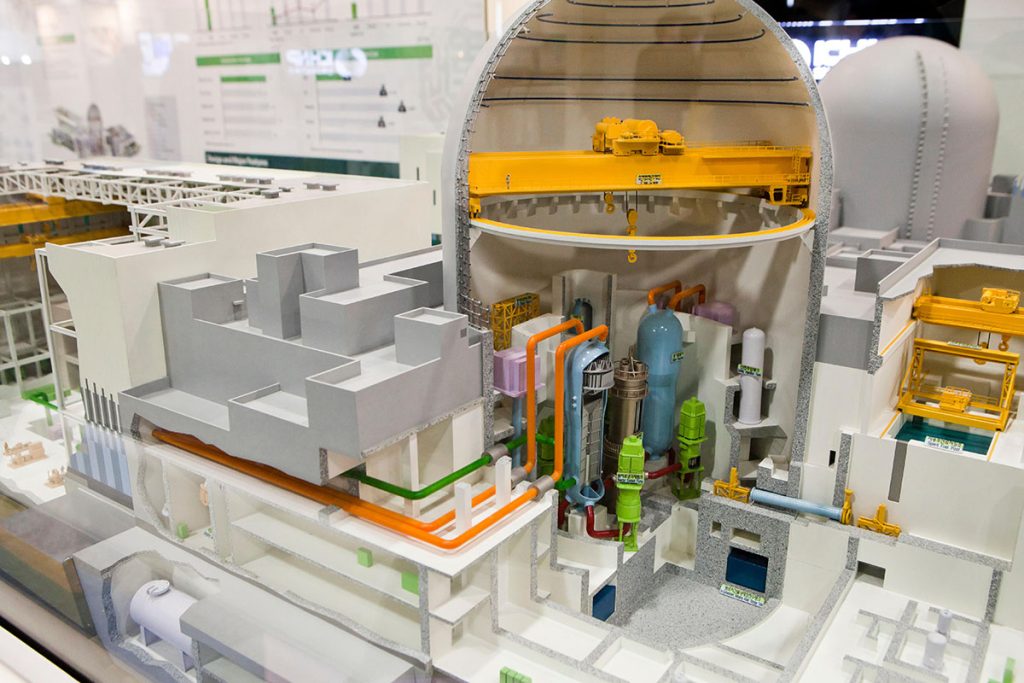
In a pressurized water reactor, water circulates in a sealed primary loop, carrying heat out of the core while remaining liquid under high pressure. The hot water flows to steam generators, where it passes heat to a separate loop that turns water into steam that spins a turbine to generate electricity. After a shutdown, there are still small amounts of heat that need to be removed, so the plant has several systems to handle heat removal. If pumps are not available, the APR-1400 reactor can use natural circulation. As warmer water rises and cooler water sinks, the system keeps heat moving safely.
While reactor designs such as the APR-1400 are built with multiple safety systems, improving how uncertainty is modeled and quantified—especially in accident scenarios—remains an important focus in nuclear safety research.
Yacine Addad, the project’s lead researcher and deputy director of the Emirates Nuclear Technology Center at Khalifa, realized there was a need for a focused ‘rare events’ study to analyze scenarios where active cooling pumps become unavailable and cooling has to rely on natural circulation. After several brainstorming sessions with colleague Antonio Cammi and scientists at EPRI, the group decided to work together on the project.
The team is using AI and machine learning to find uncertainties in simulations of natural circulation systems. “We are building tools that quantify uncertainty so we can demonstrate, with evidence, that the plant behaves safely under rare scenarios,” Addad says.
Since full-scale, on-the-ground experiments under accident-like conditions are not possible, analysts depend on validated computer models and data from scaled-down facilities to study plant behavior.
“The more knowledge we have, the more safety we have. “
Antonio Cammi
“Because experimental data from full-scale systems is so limited, a key need is to quantify how certain we are about the simulations themselves,” Addad says. “Our work uses AI to extract uncertainty information from high-fidelity simulations of natural circulation. The goal is to provide scalable data that strengthens safety analysis and supports licensing and operational decision-making.”
The model will run multiple, rapid simulations of situations where natural circulation could be affected by certain conditions. It will track potential changes in temperature and pressure and evaluate how reliably passive cooling continues to safely remove heat. By using AI and machine learning, the model will be able to “explore a large number of possible scenarios” while crunching the data far faster than conventional computer models, Cammi says.
Computations that can normally take days or weeks can be done in minutes. “The idea is we can use these new AI approaches to improve both safety and efficiency,” he says.
The ultimate test is whether this tool can reliably simulate real-world accident behavior, says Choi. “Can we demonstrate this technology is feasible [in real-world conditions]?”
Barakah is notable for its two-loop cooling design, he adds. Many large, pressurized water reactors use three or four loops. “Because it’s the largest nuclear plant in the Arab world and uses a two-loop layout at utility scale, there is a great deal we can learn from that reactor from an academic point of view.”
The Khalifa team will build the AI framework and run targeted simulations to understand where uncertainties occur, then organize the data in a reusable dataset. EPRI will then use this dataset and methodology to improve safety analysis computer software that it has already developed, says Addad.
“The more knowledge we have, the more safety we have,” Cammi says.