Making a splash in the water industry
Faisal Al Marzooqi is unlocking hidden riches in the UAE’s desalination waste.
Helping the next generation of scientists flourish, while supporting the UAE’s national goal of transforming wastewater into valuable, reusable products, are the aims of Faisal Al Marzooqi, deputy director of the Center for Membranes & Advanced Water Technology (CMAT) at Khalifa University.
“People call the water industry the ‘absent present’ sector,” says Al Marzooqi, “It’s ‘absent’ because we take it for granted, since we have easy access to water and it is always readily available. Then it’s suddenly very ‘present’ when something goes wrong and we lose access to it.”
Al Marzooqi has focused his career on developing innovative technologies for the water and energy industry. “His Highness Sheikh Mohamed Bin Zayed said water was more valuable than oil for the UAE, and this really inspired me,” says Al Marzooqi who works mainly on specialized membranes for filtering and retrieving valuable elements from water sources, with applications across multiple disciplines.
Al-Marzooqi’s lab is built on trust, curiosity, and mutual respect, a place where mistakes are seen as part of the learning journey.”
Alaa Shaheen
“My earliest research experience showed me how chemical engineering touches all areas of humanity, and has numerous applications from oil and gas to medicine and therapeutics,” says Al Marzooqi whose PhD was a combined project between Masdar Institute and the Massachusetts Institute of Technology, focusing on the application of nanotechnology in the water industry. Following his PhD, he spent several years at MIT as a visiting Assistant Professor working on solar-powered water treatment technologies in collaboration with Professor Evelyn Wang, who is now vice president of MIT.
Waste to health and wealth
Al Marzooqi is currently working on several projects with different collaborators and colleagues at KU. “Khalifa University is one of the top UAE institutes for researching energy and water,” he says.
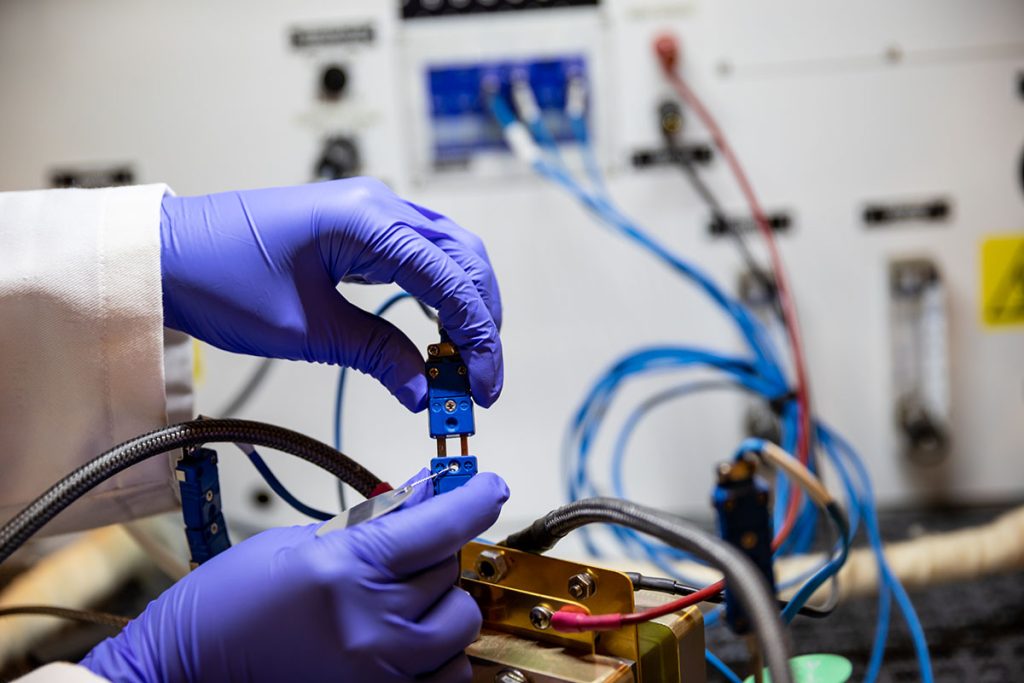
One project focuses on recovering minerals from the brine generated by desalination plants.
“Harvesting minerals will help ensure that we can cater for global technological advances in the future,” says Al Marzooqi. “After all, they say you can recreate the periodical table from all the elements that are found in seawater.”
One of the UAE’s key national goals is to ‘change waste to health and wealth,’ and Al Marzooqi is playing a leading role in bridging the gap between basic science and real-world applications in this area.
He and his team identified the conditions for improving the recovery of valuable minerals like magnesium, helping the research community to enhance extraction technologies. “We’ve also published several papers on lithium recovery, and we’re involved in refining sustainable ways to produce hydrogen from water and ammonia.”
Al Marzooqi also leads a project focused on the recovery of minerals from water emerging during the process of oil extraction. Another project involves converting waste into valuable materials for the water industry, contributing to the UAE’s move toward a circular economy. Additionally, he serves as co-principal investigator on a project led by KU’s Ahmed Al Hajaj to develop nanomaterials for heat recovery.
A team built on trust
Despite leading multiple projects, Al Marzooqi finds deep fulfilment in teaching and mentoring the next generation of scientists. “I love teaching, and working closely with both undergraduate and graduate students,” he says. “There are great researchers and great students here, and you need both to flourish in an academic environment.”
One of Al Marzooqi’s research associates, Alaa Shaheen, recalls feeling immediately welcome when she joined his team.
“It all started with a LinkedIn message, when Dr. Al Marzooqi reached out and offered me a research associate position in the chemical engineering department. At the time, my background was in simulation, and I told him that I was interested, but had no experimental experience’. He immediately reassured me, saying, “No issue. We’re one team here, and we learn together to grow.” That line captured exactly how he leads,” Shaheen says.
“What truly distinguishes Dr. Faisal is his integrity, kindness, and the genuine care for those he works with. He leads by example, always treating others respectfully and encouraging a balanced work-life.
I’ll always be grateful for the trust he placed in me. Dr. Faisal was more than a supervisor—he believed in people’s potential. Working under his supervision wasn’t just a milestone; it shaped who I am, and his character has left a lasting impression on me.”
Alaa Shaheen
Shaheen describes Al Marzooqi’s lab as a space built on trust, curiosity, and mutual respect, where mistakes are seen as part of the learning journey. “Dr. Faisal doesn’t just assign tasks; he explains the ‘why’ behind each experiment and encourages critical thinking. He often says, ‘Don’t hesitate to contact me if you have any questions, comments, or concerns.’ He truly means it and that mindset creates a space where I felt safe to learn and ask for help.”
Despite having no lab experience when she first joined, Shaheen says Al Marzooqi’s leadership and mentoring gave her and fellow students the confidence to take initiative, develop new skills, and build a strong foundation in experimental research.