Brains in the sky help protect drone flights
KU researchers are working with partners at home and abroad to protect unmanned aerial vehicles from cyberattacks.
From searching for lost hikers to delivering life-saving medicines to people in remote areas, unmanned aerial vehicles (UAVs) have become a common sight in the sky. But the true power of these drones emerges when they’re operating as an autonomous coordinated swarm with individual aircraft communicating with each other in real time to dive into wildfires, map floods and help orchestrate rescue efforts after natural disasters.
Yet as drone technology grows more sophisticated, so does the need to make them secure and protect them against interference or deliberate hacking attempts.
Secure and reliable flight control is needed to “enable safer and more trustworthy autonomous UAV operations, protect systems from cyberthreats and improve resilience in robotics platforms,” says Rafail Psiakis, a computer security expert at Abu Dhabi’s Technology Innovation Institute (TII).
Silicon chips in the driving seat
To achieve this, the TII is collaborating with researchers at Khalifa University to design and test the advanced silicon chips that will power the new generation of secure drones, using cutting-edge digital techniques.
“As the leading research university in the country, Khalifa University combines access to advanced design tools, faculty expertise and an established network of industry and government partnerships,” Psiakis says. “This positions the university not only to deliver technically but also to anchor the development of a sustainable chip-design capability within the UAE.”
“The Shaheen chip has physically unclonable function that creates a unique digital footprint, making it even more difficult for hackers to take control of the drone.”
Huruy Tesfai
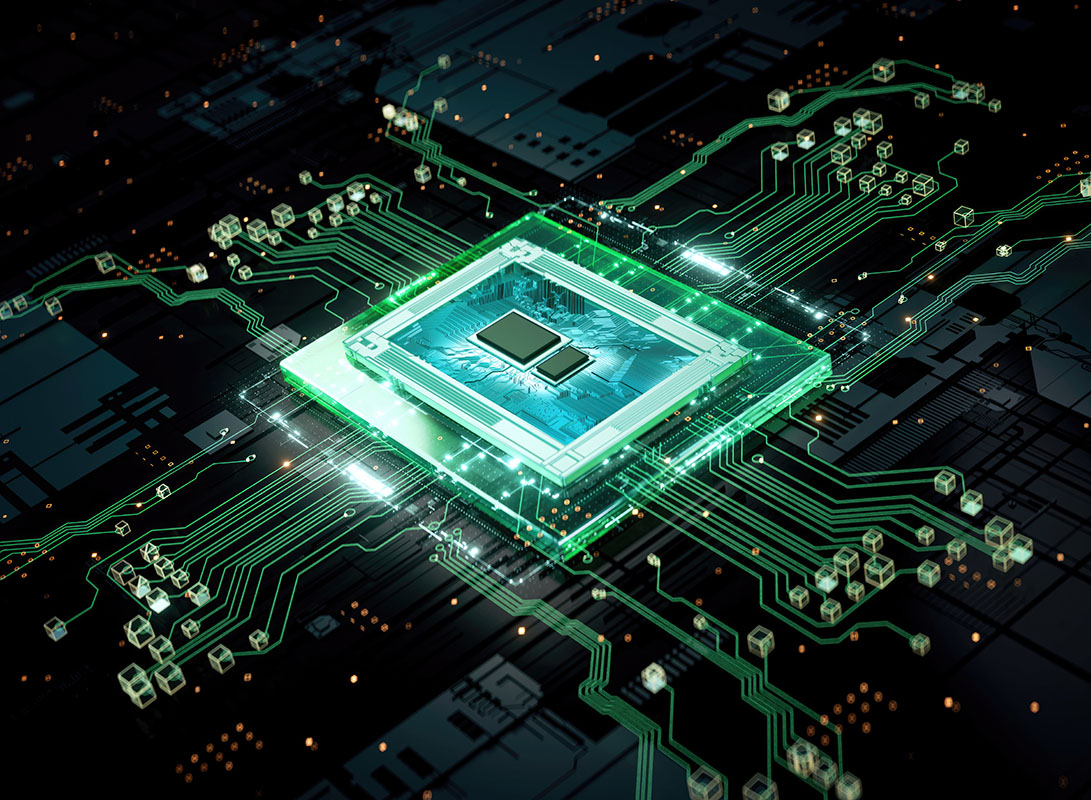
At the heart of every autonomous drone is the system-on-chip (SoC), a tiny brain handling flight control, sensor integration, communication and other onboard computations. These micro-powerhouses combine all the essential components of a computer system—a central processor, memory, and storage—onto a single piece of silicon. Like the chip in your smartphone, SoCs are cheaper and smaller than bulkier separate components, making them ideal for drone flight.
“It helps to improve the performance and make them more efficient while maintaining the security,” says Huruy Tesfai, a postdoctoral researcher working on the project. Khalifa University’s SoC Lab has been driving the initiative since its launch by the TII, the applied research pillar of Abu Dhabi’s Advanced Technology Research Council in 2021.
The dedicated SoC Lab—the only facility of its type in the region—helps bridge the gap between fundamental research and market-ready solutions. “We are probably the only lab that can do the whole workflow needed to produce the chip,” says Baker Mohammad, the director of the lab. “We make sure that it passes all the tests.”
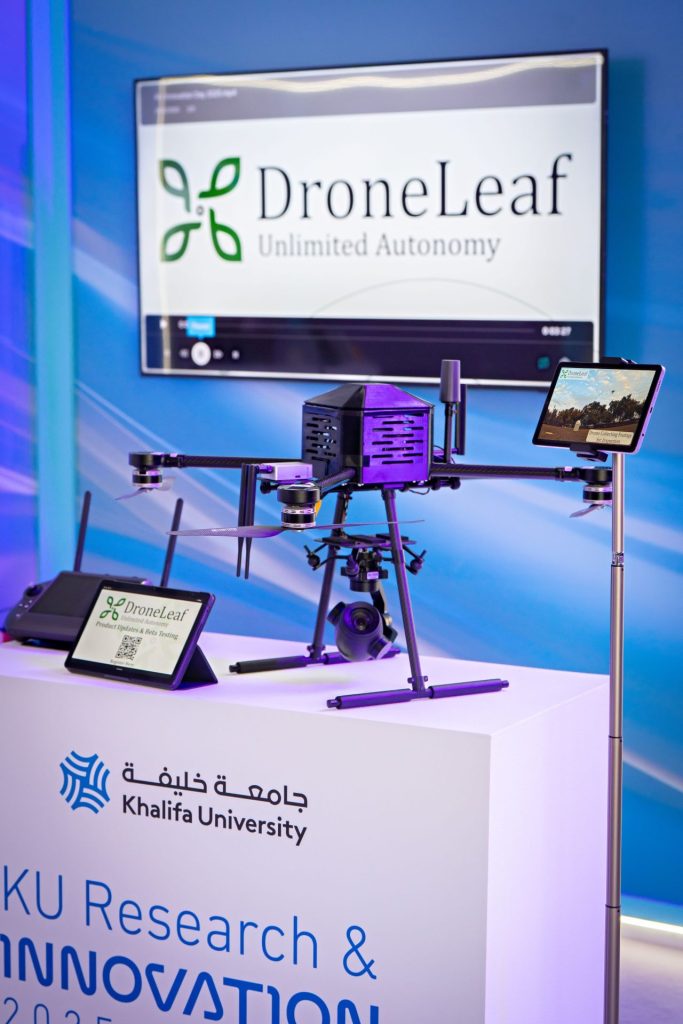
The Khalifa and TII teams aren’t working in isolation. They collaborate closely with colleagues across five other partner institutions—two universities in Italy, two in Canada and one in Portugal. Each partner contributes specialized expertise and facilities to focus on specific strengths and accelerate the project’s efficiency.
“We usually directly communicate with partners at the University of Bologna,” Tesfa says. “They’re responsible for the systems-level and hardware design. We are mainly responsible for the physical implementation of the system on the chip.”
Unclonable designs guarantee secure chips
Existing drones rely on commercially available parts and systems, making them an easy target for cyberattacks. True cybersecurity requires bespoke and carefully designed components. “The main goal of the project is to replace the existing commercially available system on chip architectures with our own chip.”
To do this, the collaborative work is built on RISC-V—an open-source computer system that allows users to build their own chip architectures without royalty payments. This system is widely seen in the field as the best way to drive innovation.
The KU group takes the hardware designs produced by their Italian partners using RISC-V and verifies their functionality. Other partners then integrate the software needed to complete the chips.
“The collaboration has been very productive,” Psiakis says, adding that it has already completed two ‘tape-outs’—the chip industry’s term for a design that is completed and ready to be fabricated.
The first chip, produced in 2022, is called Shaheen—Arabic for falcon. This chip has “physically unclonable function that creates a unique digital footprint, making it even more difficult for hackers to take control of the drone,” says Tesfa.
Independent expertise
Shaheen’s unveiling signalled a landmark in the UAE’s quest for technological sovereignty, proving its ability to develop such chips independently. This ambition is further underscored by KU’s dedicated training of graduate students in advanced semiconductor design.
The second chip is in final testing, Tesfai says. “Once it’s complete we’ll pass it to the software partners and they will take it from there.”
The next stage will be to build a demonstration drone to showcase the chip’s capabilities. Future iterations could be aided by further integration of artificial intelligence and machine learning. Those technologies will allow unmanned arial vehicles and other devices to “process sensor data, run intelligent algorithms and adapt in real time without relying on cloud connectivity,” Psiakis says. And thanks to the work of Khalifa researchers and its partners, that can all be done more securely.